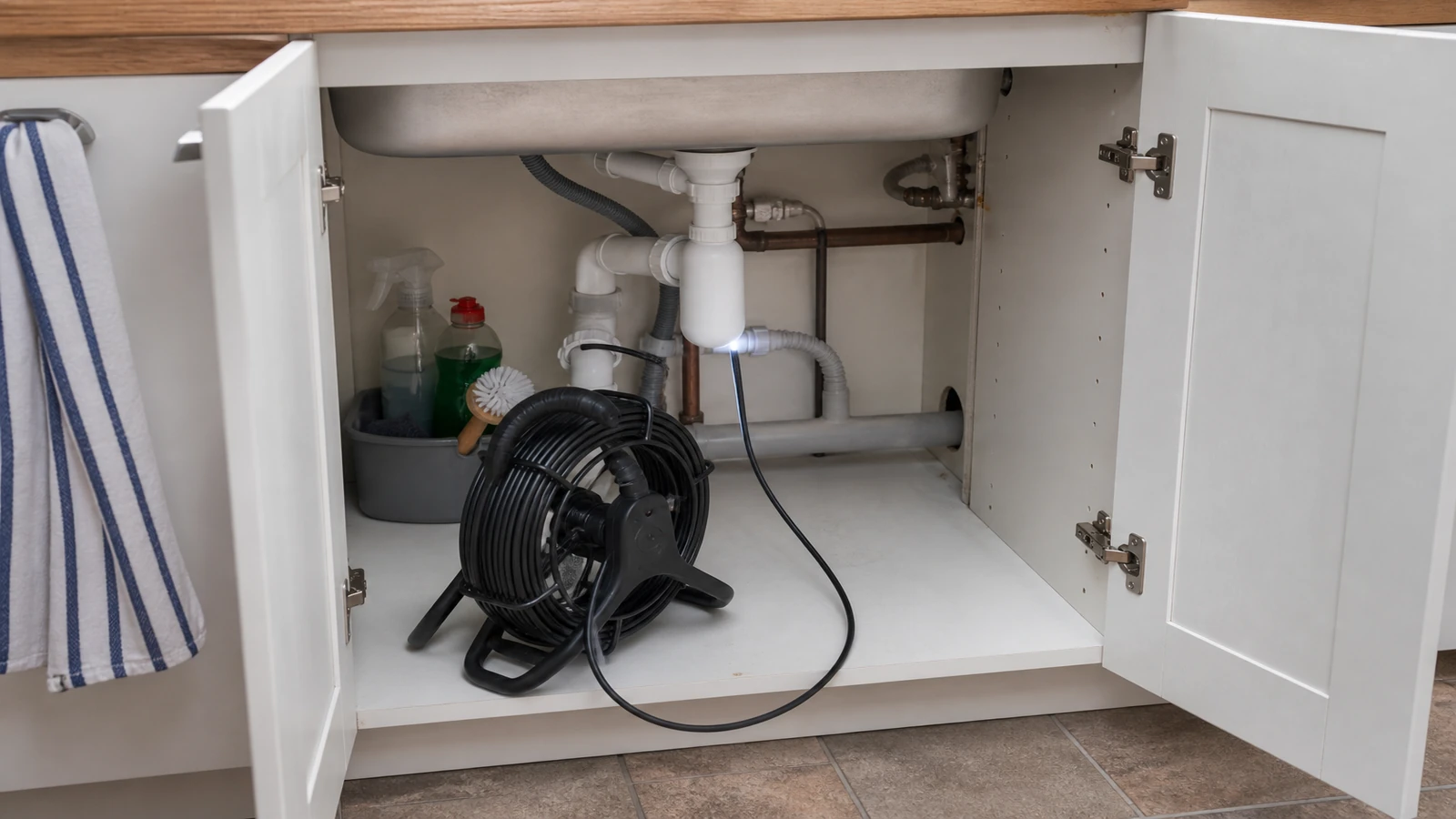
Short answer: A camera can help before calling a plumber only when the useful view is dry, accessible and outside the working waste pipe. It may show a loose fitting, an object behind the cabinet or the route around an exposed trap, but it cannot identify every cause of slow drainage. The Hayve listing documents a 7.9 mm lens figure, adjustable LEDs and a 5-metre semi-rigid cable. It gives no liquid-use or cleaning procedure, so keep the check visual and external rather than inserting the camera into standing water, contaminated waste or a sealed pipe.
Key takeaways
- Use the camera only for dry, accessible views around the sink cabinet and exposed pipework.
- A visible obstruction near the cabinet does not establish the full cause of a blockage.
- Stop and call a plumber when access requires dismantling, force or contact with waste water.
Decide whether there is a safe view to inspect
Start by separating a cabinet-space problem from a pipe problem. A camera may be useful for seeing behind the cupboard, under the bowl or around the outside of an exposed trap where direct sight is awkward. If the only route is inside a wet waste pipe, the available product information does not establish a suitable liquid-use procedure.
Do not treat a dark patch, deposit or object on screen as a diagnosis. Position, lighting and reflections can change how a small image appears, and the camera does not measure flow or identify damage hidden beyond its view.
| Situation | Camera role | Next decision |
|---|---|---|
| Dry void behind the cabinet | Check for a visible object or obvious external leak path | Photograph separately or describe the location to a plumber |
| Standing water or wet waste pipe | No supported use established by the available listing | Do not insert the camera |
| Repeated or unexplained blockage | A view cannot establish the underlying cause | Arrange professional assessment |
Set up a limited visual check
Clear the cupboard and make sure the sink is not being used while you look. Measure the narrowest dry access gap, but do not use the listed 7.9 mm lens figure as the full camera-head diameter because the listing does not provide that dimension. Use the adjustable LEDs at the lowest level that gives a readable image, because bright reflections from plastic or metal can hide detail.
Guide the semi-rigid cable gently and keep sight of where it enters. Resistance is a reason to stop, not to push harder. The purpose is to see an accessible space, not to clear, probe or test the pipe.
- Stop using the sink and remove loose items from the cabinet.
- Identify a dry access route that does not require opening the waste system.
- Measure the gap and confirm the complete camera-head diameter from supplied instructions before insertion.
- Adjust the LEDs, guide the cable without force and note the visible location.
- Withdraw the cable if the route becomes wet, contaminated or obstructed.
Know what the picture can and cannot answer
The screen can help with location: for example, whether an object is behind the cabinet or whether an exposed fitting appears displaced. It cannot confirm that pipework is sound, determine why water drains slowly or show conditions outside the lens view.
Describe findings in plain language, including where the lens was positioned and what remained out of sight. That is more useful than presenting the image as proof of a cause.
Limits and checks before using the camera
The current listing does not specify the complete camera-head diameter, focus range, cleaning method, chemical resistance or an insertion procedure for waste pipes. Its IP67 wording does not state the protected components or establish that the camera can be sanitised after contact with contaminated water.
Choose this product for a dry, non-invasive look around an accessible sink area only. If the blockage persists, water backs up, a fitting must be removed or the safe route is uncertain, use a plumber rather than extending the camera check.
Related guides and product details
Buy only for a dry, accessible visual check after confirming the complete camera-head diameter and that the 5-metre cable suits the route. Read Borescope Camera for a Car Engine: A Practical UK Guide for related guidance. Read Find a Dropped Nut in an Engine Bay with a Borescope for related guidance. Review the documented specification on the Endoscope inspection camera 5m, 4.3" ips screen industrial product page before ordering.
Sources and safety context
- Supports the 7.9 mm lens wording, cable length, screen, adjustable lighting and limited IP67 wording. Current Hayve product page.