
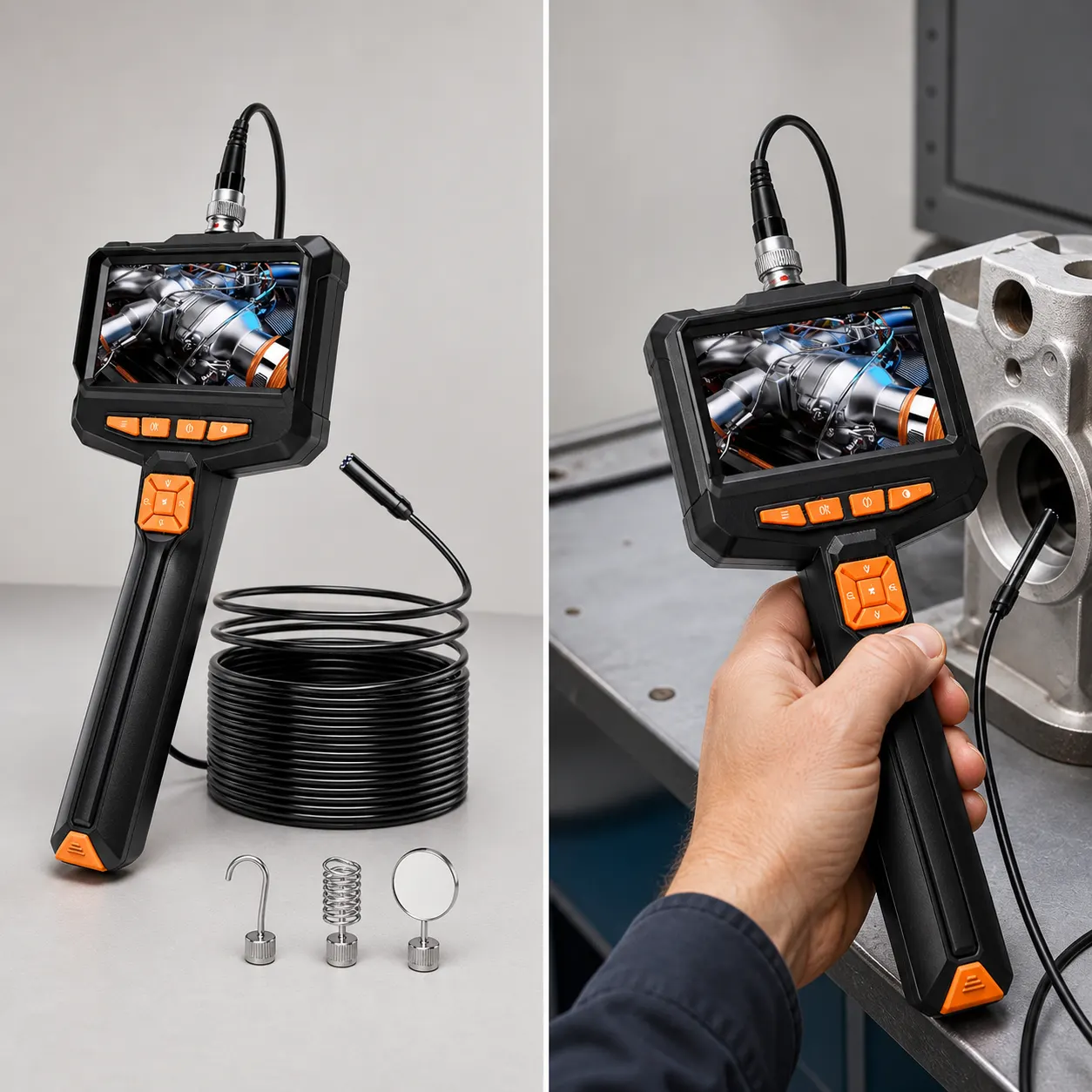
Short answer: A borescope camera for a car engine should be chosen around the exact access opening and the view you need, not around resolution alone. The Hayve listing gives useful comparison points: a 7.9 mm lens figure, 5-metre semi-rigid cable, eight adjustable LEDs and a built-in 4.3-inch screen. It does not state the complete camera-head diameter or confirm compatibility with a spark-plug bore, cylinder, fluid passage or engine layout. Use vehicle-specific workshop information and keep the camera away from moving, hot or energised parts.
Match the camera to the engine access point
Identify the intended entry before buying. An opening at the top of the engine, a gap behind a component and a manufacturer-defined service port have different shapes and risks. Compare the narrowest part of the complete route with the complete camera-head diameter from supplied instructions, allowing for bends and obstructions rather than measuring only the entrance.
The 5-metre cable supplies more reach than many under-bonnet jobs require, but length does not prove that the semi-rigid cable can negotiate a particular bend. Plan how the cable will be controlled and recovered without touching belts, fans or hot surfaces.
| Check | Documented Hayve detail | Buyer decision |
|---|---|---|
| Entry diameter | 7.9 mm lens figure; complete head diameter not stated | Confirm the full head dimension, then measure the narrowest point in the route |
| Reach and guidance | 5-metre semi-rigid cable | Confirm the route can be followed without force |
| Dark cavity | Eight adjustable LEDs | Check whether glare or reflections may obscure the target |
| Viewing method | Built-in 4.3-inch IPS screen | Decide whether live on-tool viewing is sufficient |
Prepare the vehicle before looking
Follow the vehicle manufacturer's workshop information for access and isolation. HSE guidance for motor vehicle repair highlights risks from moving vehicles, engines and components, so secure the vehicle and prevent unexpected movement or start-up before the lens enters an engine area.
Wait for parts to reach a safe working temperature and remove only components that the applicable workshop procedure permits you to remove. Do not improvise around hybrid or electric vehicle systems; HSE notes that these vehicles can expose workers to significantly higher voltages and may require specialist competence.
- Define the target and find the vehicle-specific access procedure.
- Secure the vehicle and prevent unintended engine start or component movement.
- Allow hot parts to cool and confirm the route is free of fluid and loose debris.
- Measure the access route and confirm the complete camera-head diameter before insertion.
- Guide the cable gently, stop at resistance and withdraw it along the same route.
Interpret the live image cautiously
Use the picture to describe location, colour, shape and whether an area is visible. Do not use a single view to declare that a component has failed or that an engine is serviceable. Lighting angle, focus and deposits can produce an ambiguous image.
If a finding could change a repair decision, compare it with the vehicle manufacturer's specifications or ask a competent technician. The camera can reduce unnecessary dismantling only when the available view is clear enough to answer a defined question.
Limits and checks before buying
The current listing does not specify the complete camera-head diameter, focus range, operating temperature, oil or fuel resistance, articulated lens movement or compatibility with named engines. It also does not state that images can be saved or exported.
Choose the camera only when live viewing is enough, the complete head dimension is confirmed for the measured route and the engine can be made safe for the intended access. Otherwise select equipment documented for the vehicle and task.
Related guides and product details
Compare the measured engine access and the vehicle procedure with the documented Hayve dimensions before ordering. Read Find a Dropped Nut in an Engine Bay with a Borescope for related guidance. Read Engine Inspection Camera UK: What to Compare Before Buying for related guidance. Review the documented specification on the Endoscope inspection camera 5m, 4.3" ips screen industrial product page before ordering.
Sources and safety context
- Supports the documented screen, lens, cable and lighting details. Current Hayve product page.
- Supports the need to control vehicle, engine and workshop hazards. Health and safety in motor vehicle repair and associated industries.
- Supports the competence boundary around high-voltage vehicle systems. Electric and hybrid vehicles.