
Short answer: An 8 mm-class inspection camera is suitable for an engine-bay view only when the complete access route is wider than the complete camera head and can be followed without force. The Hayve listing specifies a 7.9 mm lens figure, which falls within the size buyers often mean when searching for an 8 mm camera, but it does not state the complete head diameter. It also lists a 5-metre semi-rigid cable, adjustable LEDs and a built-in screen. Measure bends and obstructions, secure the vehicle and keep the lens away from hot, moving or energised components.
Understand what 8 mm-class means here
The current product page gives 7.9 mm as the lens figure. Use it to identify the product class, but confirm the complete camera-head diameter before making a fit decision. A nominal 8 mm search term is useful for finding the category, but it is not a tolerance.
Allow clearance for the shape of the lens housing, cable approach and any lip inside the opening. If the route cannot be measured reliably, do not infer fit from the entrance alone.
| Route condition | Fit decision |
|---|---|
| Opening clearly wider than the complete camera head throughout | Potential fit, subject to the unlisted head dimension, bends and safe access |
| Entrance near 8 mm with an internal lip | Fit remains uncertain |
| Sharp bend immediately after entry | Cable route may be unsuitable |
| Opening cannot be measured | Do not assume compatibility |
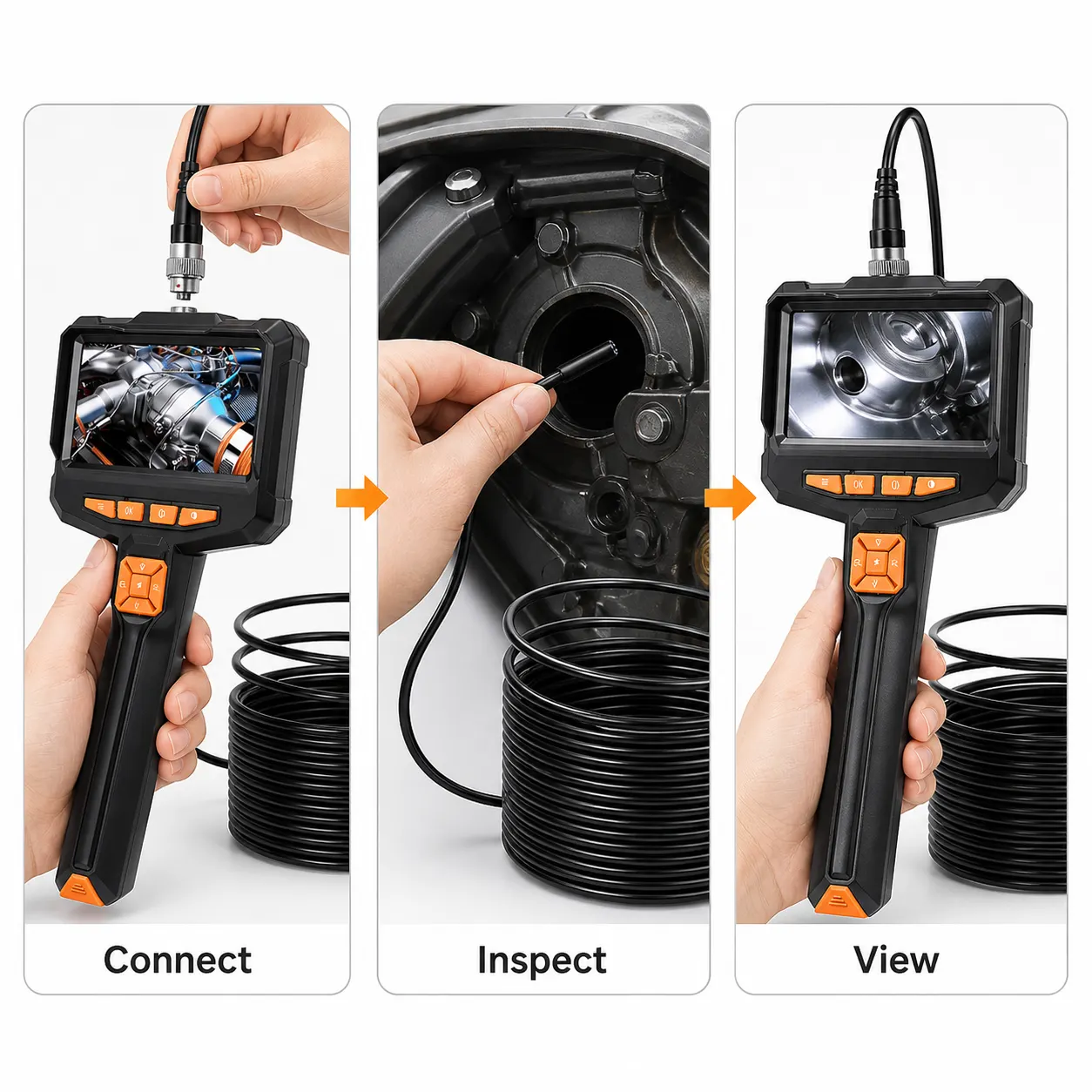
Map the engine-bay route
Sketch the entry point, direction changes and target before using the camera. The 5-metre semi-rigid cable can provide reach, but the listing does not state its minimum bend radius or compatibility with a particular bore or service opening.
Manage unused cable outside the bay and keep it clear of the floor, controls and hot surfaces. More reach should not create an uncontrolled loop near moving parts.
- Consult the vehicle-specific procedure for the intended access point.
- Secure the vehicle and prevent unintended engine or fan operation.
- Measure the entrance and any visible internal restriction.
- Plan the cable route and position the built-in screen.
- Advance without force and stop if the lens or cable catches.
Use lighting without over-reading the image
The eight adjustable LEDs can illuminate a dark area, but reflective metal, oil films and steep angles may still obscure detail. Begin at a lower setting and compare more than one viewing angle when possible.
A stated 1080x1920 resolution does not establish focus range or prove that a mark represents damage. Use the image to support a defined observation, then apply the vehicle manufacturer's criteria.
Limits and compatibility checks
The current listing does not state the complete camera-head diameter, focus range, minimum bend radius, operating temperature, oil or fuel resistance, articulated movement or named-engine compatibility.
Do not purchase for a spark-plug bore, cylinder or fluid passage unless its required diameter, environment and access procedure are separately documented and compatible.
Related guides and product details
Buy on the exact 7.9 mm measurement and the complete route, not on the rounded 8 mm search phrase. Read Inspection Camera for a Small Business: A Buying Checklist for related guidance. Read Inspection Camera UK: A Measurement-First Buying Guide for related guidance. Review the documented specification on the Endoscope inspection camera 5m, 4.3" ips screen industrial product page before ordering.
Sources and safety context
- Supports the exact 7.9 mm lens, cable, lighting, screen and resolution claims. Current Hayve product page.
- Supports precautions around vehicle movement and engine hazards. Health and safety in motor vehicle repair and associated industries.