
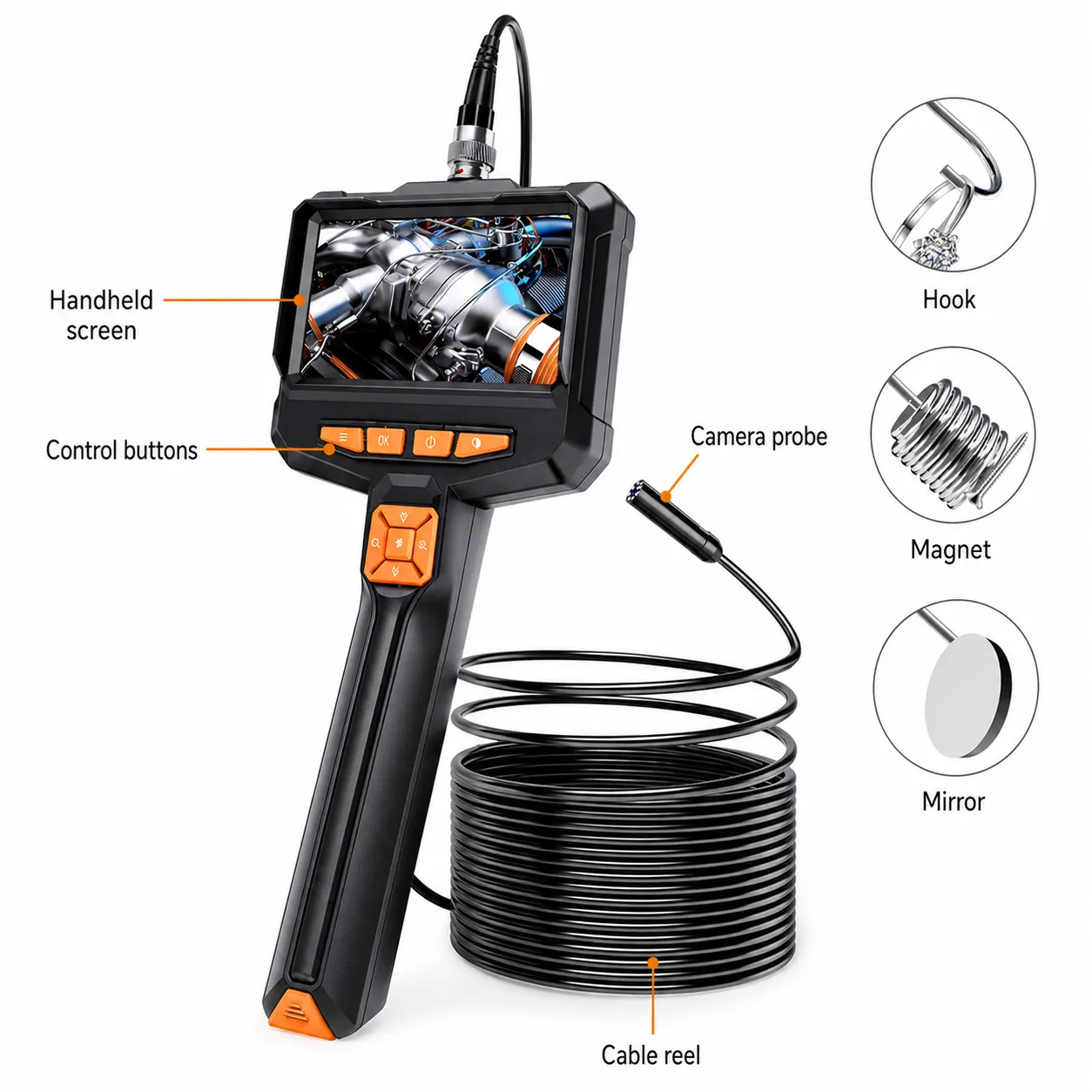
Short answer: For an engine inspection camera in the UK, buy against a defined access route rather than a broad promise of engine suitability. The Hayve listing documents a 7.9 mm lens, 5-metre semi-rigid cable, eight adjustable LEDs, a 4.3-inch IPS screen and stated 1080x1920 resolution. These are useful comparison points for live viewing around a stationary vehicle. They do not establish compatibility with every engine opening, fluid, temperature or electrical system. Measure first, follow the vehicle manufacturer's workshop information and rule out any job that requires unsupported environmental resistance or specialist high-voltage access.
Compare access, reach and cable control
Write down the narrowest opening, total route length and number of bends for the intended job. Compare those measurements with the 7.9 mm lens and 5-metre cable. A semi-rigid cable may help hold a shaped route, but the listing does not give a minimum bend radius or a guarantee for a named engine.
Extra cable length is useful only if it can be managed outside the engine bay. Plan where the unused cable and screen will sit so they cannot fall onto hot or moving parts.
| Buying factor | Listed specification | Question to answer |
|---|---|---|
| Camera entry | 7.9 mm lens | Is every part of the access route wider than this? |
| Cable | 5 metres, semi-rigid | Can it follow the route without force or sharp bending? |
| Lighting | Eight adjustable LEDs | Will the target create glare or remain shadowed? |
| Display | 4.3-inch IPS screen | Is live on-tool viewing enough for the task? |
Compare the viewing workflow
The built-in screen means the listing does not require Wi-Fi, an app or a smartphone. That can simplify a shared garage workflow because the camera and display are one unit. The stated resolution is a listed output figure, not evidence that every fault or surface mark will be identifiable.
Decide before purchase whether one person must guide the cable and watch the screen at the same time. Screen position, ambient light and access angle can matter as much as the display specification.
Set safe boundaries for vehicle use
HSE guidance for motor vehicle repair identifies risks from vehicle movement, engines and associated systems. Use the relevant vehicle procedure to secure and isolate the work area before introducing the camera, and keep it away from moving or hot parts.
For electric and hybrid vehicles, HSE highlights significantly higher voltages and the need for suitable skills and precautions. A general inspection camera specification does not establish permission to access high-voltage components.
- Define the exact view and consult the vehicle-specific workshop information.
- Secure the vehicle and prevent unintended start-up or movement.
- Allow the intended route to cool and check it is dry and unobstructed.
- Measure the opening and map cable placement outside the engine bay.
- Stop if the route approaches a system outside your competence.
Limits and checks before ordering
The current listing does not state operating temperature, fuel or oil resistance, focus range, articulated movement, image saving, export or named-vehicle compatibility.
Do not buy this model for a task that depends on any of those points without separate documentation. It is a candidate for measured, live viewing around a safely prepared vehicle, not a universal engine diagnostic instrument.
Related guides and product details
Use the product page as a dimensions checklist, then buy only when the vehicle procedure and measured route agree with it. Read Hayve Industrial Inspection Endoscope Camera Buying Brief for related guidance. Read How to Choose an Inspection Camera for a Workshop or Garage for related guidance. Review the documented specification on the Endoscope inspection camera 5m, 4.3" ips screen industrial product page before ordering.
Sources and safety context
- Supports the product's listed physical and viewing specifications. Current Hayve product page.
- Supports the vehicle-repair safety boundary. Health and safety in motor vehicle repair and associated industries.
- Supports the specialist competence boundary for high-voltage vehicles. Electric and hybrid vehicles.